Chat with us
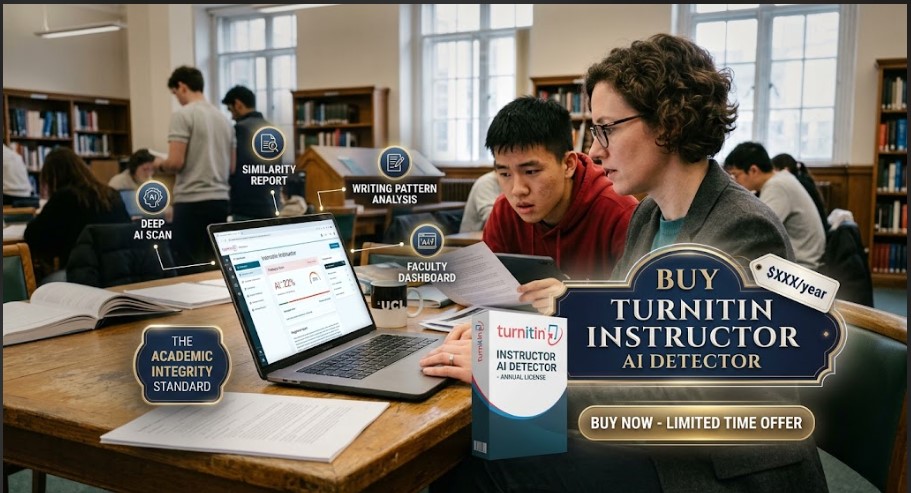
How to Buy a Turnitin Instructor Account: AI Detector Features, Pricing & Access Guide
How to Buy a Turnitin Instructor Account: AI Detector Features, Pricing & Access Guide
Premium Service Available
This is a premium service with special pricing. Visit our partner platform to get started.
Visit turniself.comAbout How to Buy a Turnitin Instructor Account: AI Detector Features, Pricing & Access Guide premium access
Buy Turnitin Instructor AI Detector: Complete Guide, Features, Pricing & Access Options
As an educator, department chair, or online course creator, you likely have encountered a big confusion hurdle when trying to purchase access to Turnitin Instructor AI Detector. On the official site, you look for a checkout button, or a standard pricing tier and only find enterprise contact forms. As you go, you continue to fill up your grading queue, students' work is in some odd way starting to look heavily alike and you need a sure way to confirm that they did the work.
I have also experienced this scenario more times over a decade of working with technologies in education in secondary and higher education. People are now more than ever seeking for reliable text verification software, but procurement remains in the dark.
This guide explains and demystifies all aspects of buying and gaining access to Turnitin's educator workspace, the real-life cost considerations, influential barriers and technology, and some handy workarounds for when institutional licensing is not available.
Turnitin Instructor Detection System (IDS): What is it?
Traditionally known for its massive and deep web crawling as well as large scale proprietary student paper database, Turnitin has long been considered the global leader in academic honesty. But the new teaching room has special text search features designed to detect not only copy-paste phrases, but computer-generated text as well.
This system is not a standalone application but rather is an integral part of the grading process. Document gets 2 analyses when opened by an instructor:
-
Similarity Score: Identifies similarity to published internet sites, magazines, or to previous student papers.
-
Writing Breakdown: Marks salient parts with recognisable characteristics of automated text generation in terms of structure, statistics and syntax.
Little does anyone know, Turnitin does not offer its state of the art verification engine in the form of an off-the-shelf consumer application. It is delivered in the institutional packages (Turnitin Feedback Studio or Turnitin Originality) specifically designed for education administration.
The reasons why Educators go for committed writing affirmation apparatuses
Grading has always been a time consuming aspect and with the changes in technology in the classroom, it's changed forever.
Modern Academic Integrity Challenges:
-
Formulaic submissions lacking personal student voice
-
Traditional web searches failing to match non-published phrases
-
Disproportionate grading hours spent auditing suspicious text
-
Need for defensible, transparent records during academic reviews
A teacher has 50 research essays to assess during a weekend, and he can't simply make a call based on gut. You need data. A systematic baseline provides a point of departure from which to have substantive discussions with students instead of objectifying the claims that it is accused of.
In addition to plagiarizing work, instructors use such systems to:
-
Establish good paraphrasing and reference practices at the beginning of the semester.
-
Ensure the legitimacy of the work of honest students.
-
Ensure that there are accredited institutional standards in remote and hybrid classes.
-
Implement a uniform system of grading in departments with several classes.
The Turnitin Instructor Workspace provides key features that help instructors more efficiently and effectively manage assignments
The modern teacher interface offers a few layers that are well integrated and they will offer the teacher a holistic student authenticity.
Turnitin Instructor Workspace Components:
-
Document Upload & Ingestion Engine
-
Originality Analysis – Matched Web & Student Text
-
Writing Pattern Audit – Statistical Flagging %
-
Instructor Suite – Rubrics, Voice Notes, Annotations
-
Automated Detection of writing patterns
The basic element that buyers seek for is the predictability of sentences and uniformity of the structure. The software instead of looking for matching words, reads the probability of a sequence of words.
Suspect blocks from the report are identified by a special visual overlay in the report and an overall percentage score is given that shows the percentage of the submission that matches synthetic generation profiles.
Deep Similarity Checking
Turnitin has the world's largest academic comparison archive:
-
More than 99 billion web pages (current and archived)
-
More than 1.8 billion decades of student papers submitted
-
Hundreds of millions of scholarly articles, books and conference proceedings through relationships with leading academic publishers that are only accessible by subscription
This means that, if a student uses automated generation and adds on the traditional cut and paste, both will be pulled up in one grading view.
Unified Instructor Dashboard
The classroom management is made easier with the instructor dashboard. Teachers can:
-
Set up customized dropboxes with certain rules for submission
-
Only allow submission of certain file types (DOCX, PDF, TXT, etc.)
-
Select whether or not students can access their own similarity reports before grading
-
Create custom assignment deadlines with auto-close
In-Line Student Submission Review (Feedback Studio)
It is only half the job to catch plagiarized work, the other half is to give the corrective instruction. Feedback Studio makes it possible for teachers to provide:
-
Colour coded comment bubbles (QuickMarks), which can be dragged and dropped
-
Strike-through text and provide suggestions that appear next to text
-
Custom rubric scoring matrices that are directly linked to the Department's criteria
-
Write 3 minutes long notes to voice for personalized and detailed feedback
To purchase Turnitin Instructor AI Detector, please follow these steps
The Turnitin licence purchase process is a somewhat institutionalised process. Due to the privacy laws in the enterprise world (FERPA, GDPR, etc.), consumer checkout accounts are normally not available directly through Turnitin.
Procurement Pathway Workflow:
-
Step 1: Determine Enrollment Scope (FTE / Student Headcount)
-
Step 2: Submit Institutional Request via Official Sales Channels
-
Step 3: Account Provisioning & Learning Management System (LMS) Setup
-
Step 4: Instructor Seat Assignment & Roster Configuration
Step 1: Institutional Inquiry
For the School, University, or Private Training Academy, your principal/prime administrator will need to make a request for a quote on Turnitin's enterprise sales website. Your annual (FTE) number of students will have to be determined.
Step 2: Departmental/Consortium Purchasing
Small private schools or independent tutoring departments may be part of a regional educational service agency (ESA) or consortium. These buying groups collect students' numbers and meet the enterprise minimums, in order to be able to purchase at agreed bulk rates.
Step 3: Individual Educator Workarounds
Individual tutors, independent researchers or adjunct professors who are not affiliated with a subscribing institution will not be allowed to swipe an official individual seat with a personal credit card.
From my experience, teachers in this situation can take 3 valid actions:
-
Departmental Sponsorship: Ask department chair for funding of a pilot program for a limited number of instructors.
-
Direct LMS Add-ons: If your institution already has a learning management system (LMS), make sure to find out if there are unallocated seats available for which you can request access via your IT administrator at your campus.
-
Stand-Alone Consumer Verification Tools: Use well-known single-seat purchase consumer verification tools (discussed further in this guide).
Turnitin Pricing and Subscriptions Breakdown
Turnitin is on a customized B2B quotation model, therefore, there is no open listed flat monthly fee. The pricing is generally based on volumes (students enrolled), tier of the product selected and complexity of integration.
| Tier | Target Users | Capabilities Available in Base Package | Pricing Basis |
|---|---|---|---|
| Turnitin Originality | Higher Ed & Large Districts | Full web similarity, contract cheating flags and higher level writing pattern detection | Annual institutional contract (Per-FTE basis) |
| Turnitin Feedback Studio | K-12 Schools & Colleges | Traditional similarity checking, grading rubrics, peer reviews, basic analysis only | Institutional contracts based on FTE or per student basis |
| Turnitin Clarity / Similarity | Small Publishing Teams / Research Labs | Focused text similarity with no full grading and classroom assignment suites | Volume-based document or seat licensing |
Important factors that can affect the final cost:
-
Student Headcount (FTE): Prices are typically almost always based on student per year as opposed to teacher.
-
Contract Type: Institutional multi-year contracts often have lower per-seat rates than do pilot contracts.
-
LMS Integration Depth: Some LMS integrations may be more useful with direct API connections, which could impact deployment and integration costs, such as with Canvas, Blackboard, Moodle, or Brightspace.
-
Annual Minimum Commitment: Enterprise contracts may feature certain minimum commitment levels and single-seat direct purchases may be unworkable for individual buyers.
Turnitin Instructor Tools can be used by various user segments
There are various administrative requirements of different education establishments. These are how the different user segments can benefit from using these instructor tools:
Target User Ecosystem:
-
K-12 & High School Teachers – Focus on foundational writing habits
-
Colleges & Universities – Protect departmental integrity & degrees
-
Online Course Creators – Scale grading across global cohorts
-
Academic Researchers – Pre-submission peer review verification
Head teachers & teachers in secondary level & High schools
The software is mostly used by secondary teachers as a formative assessment tool. At this stage students are still not fully developed in their ability to paraphrase second sources without using automatic paraphrasing shortcuts. Clear visual breakdown helps teachers to direct students to true understanding.
Colleges/Universities & Department Heads
There is no doubt that the credential integrity risks are high in higher education. Automated preliminary screening of papers in large lecture classes with hundreds of weekly submissions, by teaching assistants and professors, is necessary to free up their time for more in-depth reviews of papers with serious authenticity issues.
Online Course Creators / Bootcamps
Non-traditional educators who are delivering writing bootcamps via asynch or Certificate offerings require scalable means for auditing capstone projects. The system of strict checkpoints in their submission ensures that certificates they award have commercial value and industry credibility.
Application – Real World Classroom Case Study (Hypothetical)
To understand the value of Turnitin in every day practice in your school, take the following example into account:
The Scenario:
Dr. Henderson is a department of 1,200 undergraduate students in eight courses in the introductory humanities. Twelve adjunct teachers are grading hundreds of essays every two weeks – subjective evaluation was causing inconsistencies in academic honesty standards.
The Implementation:
The department was able to embed Turnitin's educator suite within their campus LMS. Each essay written automatically produced an integrated report which included evidence of the matching of outside sources and also evidence of identifying writing patterns.
Grading Workflow Timeline:
-
Student submits 2,000-word history essay via LMS
-
System processes document against billions of records in ~90 seconds
-
Instructor opens grading pane; notices 35% statistical alert
-
Instructor examines specific flagged passages in Section III
-
Teacher conducts formative 1-on-1 writing conference with student
The Outcome:
Instead of moving to punitive disciplinary boards, instructors used the visual reports to discuss with students during office hours information on how to take notes, create bibliographies for research, and outline structures. As students were aware of automated shortcuts being easily identifiable, there was a 40% drop in academic integrity infractions over a two-semester period.
Turnitin for Writing Verification has several advantages
Make-hift verification workflows have clear disadvantages to making an industry-standard platform:
-
Massive Comparative Data Integrity: No other commercial tool has a private repository of students' papers or offers the scope of Turnitin.
-
Seamless LMS Interoperability: Instructors won't need to manually export files and upload them to third party web portals, assignments are synchronous with the gradebook.
-
Turnitin Academic Appeals Are Defensible: The transparent, side-by-side text comparisons and explanations of the metrics are accepted by academic review boards around the world.
-
Formative Learning Support: Revision Assistant and QuickMarks enable the use of a potential disciplinary tool to become a constructive grading and feedback workspace.
Limitations and Accuracy Considerations
No Automatic Evaluation Engine is 100% accurate. It's important to be aware of any software limitations to avoid misjudgments in the classroom.
Potential Verification Pitfalls:
-
False Positives – Highly formulaic or technical text flagged
-
False Negatives – Heavily edited synthetic text evades alerts
-
Non-Native Writers – ESL students sometimes display rigid syntax
-
Lack of Proof Context – Software shows probability, not legal proof
Dealing with False Positives and Technical Jargon
Rigid syntax in writing is common in highly structured writing, for example, in a legal brief, a lab procedure, chemistry report or standardized literature review. These passages are often formulaic, written by humans, and can be detected as being created by a machine by the software.
Non-native English speakers
What most teachers experience as they teach international students and/or English as a Second Language (ESL) students is that they tend to use simpler, repetitive sentence structures. These patterns are similar to what is predictable by statistics, so teachers need to take special care in questioning the originality of an international student's work.
Best practices for instructors
-
Don't give a student a C (or F) grade for software grade alone. Use percentages as motivators to explore, rather than objective assessments.
-
Review the Document Versions. Have students bring in their Google Doc or Word version "timeline" to see the organic writing process.
-
Design and carry out a quick conversational audit. Have the student let you know what their thesis is or clarify any complicated jargon in their paper or describe how they found their sources.
Some typical errors teachers may make when purchasing and implementing
Here are some common pitfalls not to make when looking at academic integrity software:
Common Pitfalls:
-
Buying unauthorized third-party "shared instructor logins"
-
Using automated scores as standalone disciplinary evidence
-
Ignoring student data privacy mandates (FERPA/GDPR compliance)
-
Failing to train adjunct faculty on report interpretation
-
There are several untrustworthy websites selling "Black-Market Turnitin Individual Instructor Logins" at a low price. Almost always these are hijacked institutional seats. Using them can be a violation of data privacy laws, can lead to exposure of student data and can only lead to a sudden account termination.
-
Alert Rates are NOT percentages of the essay fabricated: An alert rate of 25% does not imply that a quarter of the essay is fabricated. It shows a similarity of numbers — which means that it needs to be understood by a human being.
-
Institutional Privacy Rules: This practice may be a violation of institutional privacy guidelines by uploading student(s) intellectual property to unapproved consumer web checkers. Always make sure that any platform you use is fully compliant with protecting the privacy of student data.
Alternatives for Use in Standalone Classes
When your institution does not have an official Turnitin subscription, and you are unable to enter into enterprise licensing, you can purchase a single user site license via other reputable alternative sources:
| Tool | Main Advantage | Best For | Purchasing Approach |
|---|---|---|---|
| Copyleaks | High precision text pattern analysis & code checking | Higher ed instructors & online tutors | Monthly credit packs / Individual subscription |
| Originality.ai | Rigorous multi-model content auditing service | Web publishers, editors and course creators | Pay as you go credits or monthly plans |
| Scribbr | Turnitin-powered student similarity checking | Individual students & researchers | Per-document upload fee with discounts for bulk uploads |
| Plagscan | Simple file comparison for smaller businesses | Small private schools & boutique academies | Tiered credit schedules |
Frequently Asked Questions
Is there a way that people can purchase Turnitin Instructor AI Detector?
Turnitin does not, directly through our website, offer single consumer instructors subscriptions. Access is by means of institutional licenses (universities, school districts and education providers). Each educator should get access via his/her affiliated institution or with trustworthy consumer grade products such as Copyleaks or Originality.ai.
What is the cost of Turnitin AI detector?
Pricing varies individually for each institution according to the total number of students (Full-Time Equivalent – FTE), integration needs and institutional preference for product package. Typically, annual enterprise agreements are offered starting with only a few dollars per student per year for big districts up to tiered pricing for specialized departmental deployments in which custom LMS integrations are included.
Can AI be detected by Turnitin for teachers?
Yes. Teachers get direct access to a supported package (Feedback Studio with Originality capabilities) via their regular instructor dashboard or their integrated Learning Management System (Canvas, Blackboard, Moodle, etc.), when the educational institution purchases the package.
What is the reliability of Turnitin's text analysis?
Turnitin's detection models are engineered to keep false-positive rate (FPR) extremely low – typically below 1% when documents are submitted in full, in controlled tests. But with very short text passages, and very technical lab reports or by non-native speakers of English, accuracy can be variable. It is designed to be used as a diagnostic aid, rather than a final discipline proofing machine.
In what ways is Turnitin different from other Web detectors?
Commonly-used consumer tools involve submitted text and public search engine results, or apply a stand-alone statistical algorithm. Turnitin's statistically sound text analysis technology is complemented by an unmatched proprietary archive of billions of past student papers, academic journals and gated scientific publications.
How to make the Right Choice for Your Classroom
The key to getting the right academic honesty platform is to safeguard the worthiness of learning and promote authentic student development. Although a single Turnitin subscription for instructors is not available for purchase via a consumer shopping cart, institutional licensing is still the best solution for integrated grading while also providing extensive similarity checking and defensible writing analysis.
For institutional administrators, please contact the official procurement people by phone or email directly to create a license according to the number of FTE based on the needs of your campus. For independent educators and tutors requiring immediate verification tools, look for enterprise solutions that are standalone, have straightforward pricing that is transparent and includes only one user and maintains student data privacy
How to Buy a Turnitin Instructor Account: AI Detector Features, Pricing & Access Guide service benefits
What you get
Premium Edu Tools helps you get affordable How to Buy a Turnitin Instructor Account: AI Detector Features, Pricing & Access Guide premium access for academic writing, research, productivity, and professional work. The service page shows available plans, prices where applicable, and the best way to get started.
Who it is for
This service is useful for students, researchers, writers, freelancers, educators, and professionals who need dependable access to premium educational tools without paying full individual subscription costs.
Support and delivery
After purchase, Premium Edu Tools provides service guidance and customer support through WhatsApp, email, and the contact page so customers can resolve access questions quickly.
How to Buy a Turnitin Instructor Account: AI Detector Features, Pricing & Access Guide FAQs
What is How to Buy a Turnitin Instructor Account: AI Detector Features, Pricing & Access Guide premium access?
How to Buy a Turnitin Instructor Account: AI Detector Features, Pricing & Access Guide premium access is a service from Premium Edu Tools that helps students, writers, researchers, and professionals use premium academic or productivity tools at an affordable price.
Who should use How to Buy a Turnitin Instructor Account: AI Detector Features, Pricing & Access Guide?
How to Buy a Turnitin Instructor Account: AI Detector Features, Pricing & Access Guide is suitable for students, academic writers, researchers, content creators, freelancers, and professionals who need reliable writing, checking, research, or productivity support.
How do I buy How to Buy a Turnitin Instructor Account: AI Detector Features, Pricing & Access Guide from Premium Edu Tools?
Choose the plan shown on the service page, complete the purchase process, and contact support if you need help with access or setup.
Does Premium Edu Tools provide support for How to Buy a Turnitin Instructor Account: AI Detector Features, Pricing & Access Guide?
Yes. Premium Edu Tools provides customer support through WhatsApp, email, and the contact page for service access and account-related questions.
🎯 Related Services

ChatGPT Plus Group Buy in India | @ only $4.50/M
ChatGPT Plus group buy India: Access premium AI features affordably. Join a community to share subscription costs and enjoy enhanced capabilities. Learn about benefits, legal considerations, and trusted platforms.
View ChatGPT Plus Group Buy in India | @ only $4.50/M
Chatgpt plus group buy | Quality Service | Guaranted Service
ChatGPT Plus group buy India offers affordable access to premium features like GPT-4, faster responses, and priority access by sharing subscription costs with others.
View Chatgpt plus group buy | Quality Service | Guaranted Service
Gly(G r a m m a r l y) Premium Group Buy | Quality Service
Affordable and secure access to premium tools with Gly Premium Group Buy�streamline collaboration and save up to 85% on top software!
View Gly(G r a m m a r l y) Premium Group Buy | Quality Service
Hix ai bypass group buy online starting just $7.5 per month
Hix AI Bypass Group Buy Online provides access to tools that help bypass AI detection systems, offering advanced automation for digital tasks and workflows.
View Hix ai bypass group buy online starting just $7.5 per month
Hix bypass group buy | Full warrenty Service
Hix Bypass Group Buy offers affordable access to premium services by sharing the cost with others, unlocking content and bypassing restrictions securely.
View Hix bypass group buy | Full warrenty Service
Jenni AI Group Buy | Pro Unlimited Plan | Quality Service
Stop overpaying for academic excellence. This 2026 guide reveals how to access the Jenni AI Group Buy for a fraction of the cost.
View Jenni AI Group Buy | Pro Unlimited Plan | Quality Service⭐ Customer Reviews
Join thousands of satisfied customers who trust our premium services. Your success is our priority!